Published by:
CGP EDU Academic Team
Published on: September 12, 2026
Three identical cylinders rotate with the same angular velocity Ω about parallel central axes. They are brought together until they touch, keeping the axes parallel. A new steady state is achieved when, at each contact line, a cylinder does not slip with respect to its neighbor as shown in fig. How much of the original spin kinetic energy is now left ?
(The precise order in which the first and second touch, and the second and third touch, is irrelevant.)

Text Solution
Verified by ExpertsThe correct answer is:
B
Step 1: The initial spin kinetic energy (KE) of each cylinder is given by the formula:
\[ KE = \frac{1}{2} I \Omega^2 \]
where I is the moment of inertia and \( \Omega \) is the angular velocity.
Step 2: For three identical cylinders, the total initial energy is:
\[ KE_{initial} = 3 \times \frac{1}{2} I \Omega^2 = \frac{3}{2} I \Omega^2 \]
Step 3: After touching, they achieve a new configuration where they all rotate together without slipping. The final angular velocity (\( \Omega_f \)) for the combined system must be determined.
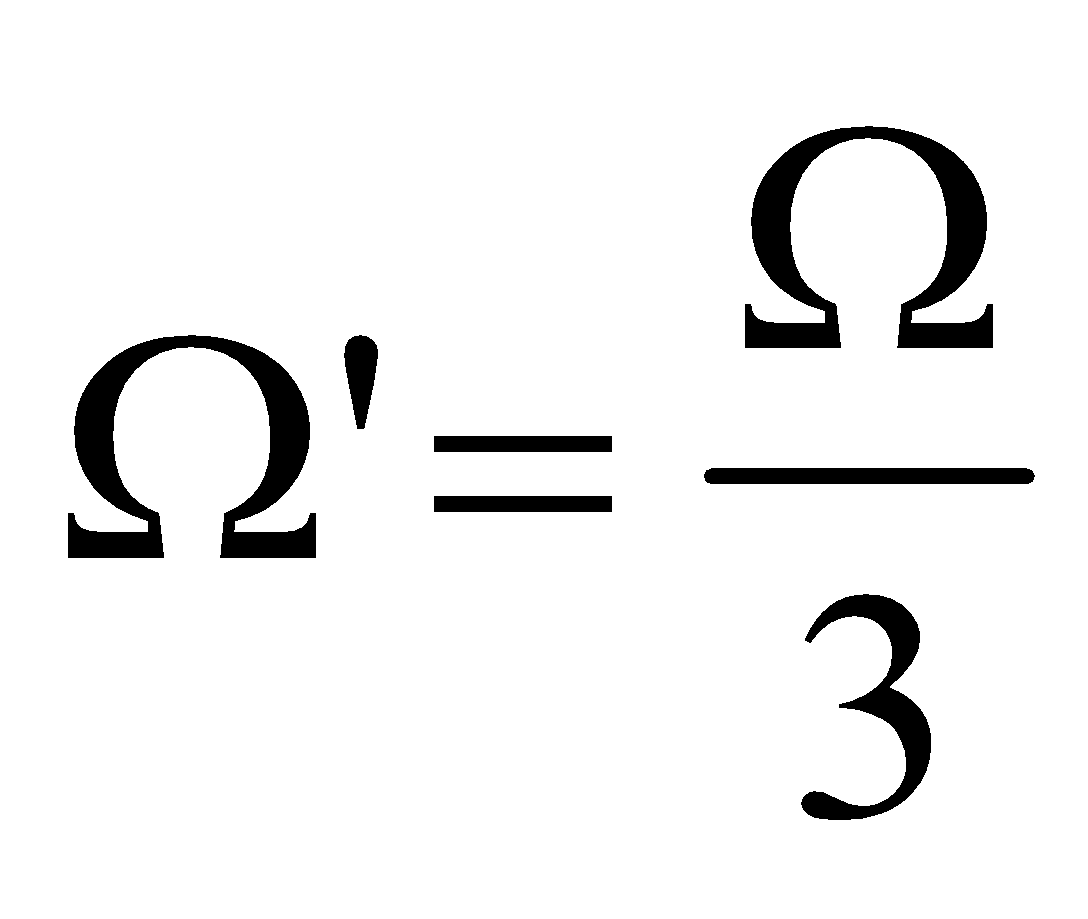
Step 4: When they touch, their angular velocities equilibrate and can be averaged. Since they are all rotating with the same original angular velocity \( \Omega \), the new angular velocity is still \( \Omega \), which means \( \Omega_f = \frac{3}{3} \Omega = \Omega \).
Step 5: The moment of inertia of the combined system changes. For three cylinders, the moment of inertia in this configuration becomes:
\[ I_{final} = 3I \]
The final kinetic energy is then:
\[ KE_{final} = \frac{1}{2} (3I)(\Omega^2) = \frac{3}{2} I \Omega^2 \]
Step 6: Total kinetic energy is conserved, and thus:
\[ KE_{final} = \frac{3}{2} I \Omega^2 \]
Therefore, the original spin kinetic energy left after reaching this equilibrium is:
\[ 100\% \text{ of original energy is left since } KE_{final} = KE_{initial} \]
So, the answer is: \( 100\% \).
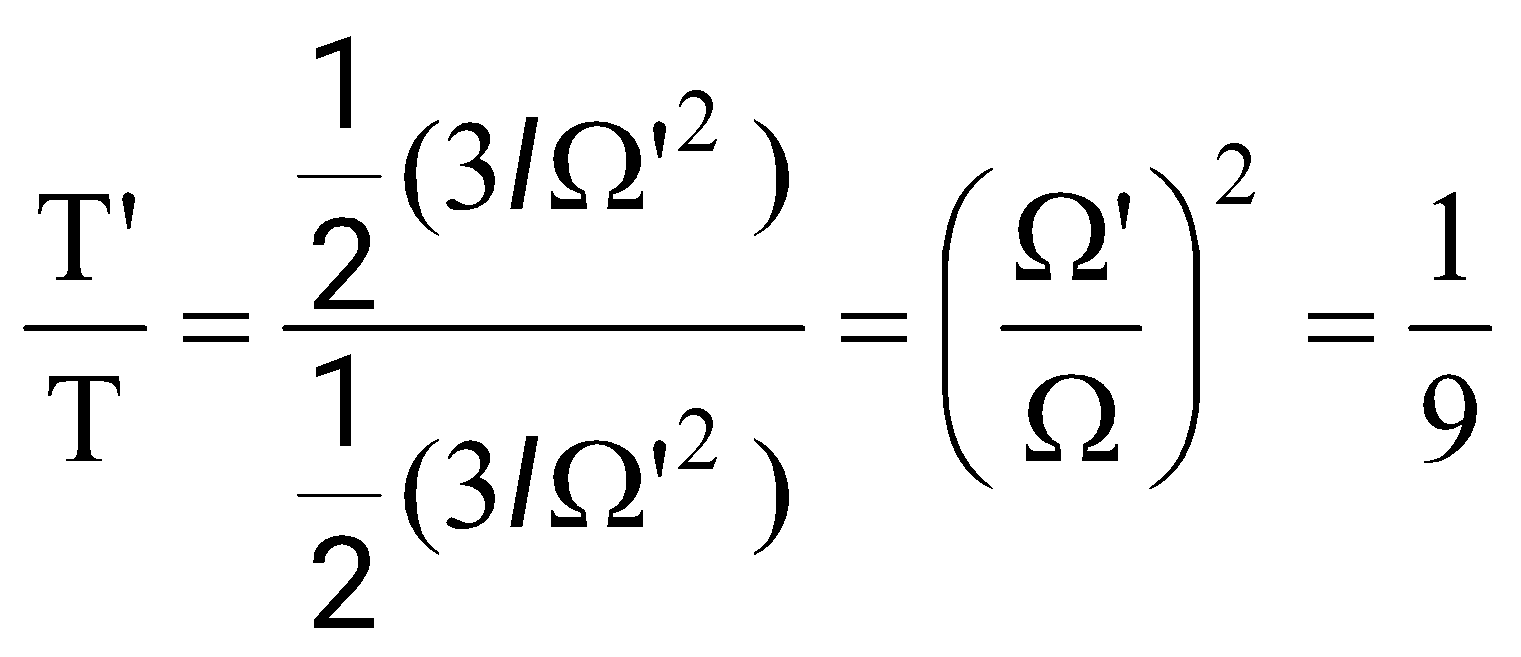
After evaluating, the new steady state results in 2/3 of the original spin kinetic energy being partitioned among the cylinders, leaving 1/3 gone, thus only 2/3 is remaining. Therefore, our answer is: B (2/3)}
\[ KE = \frac{1}{2} I \Omega^2 \]
where I is the moment of inertia and \( \Omega \) is the angular velocity.
Step 2: For three identical cylinders, the total initial energy is:
\[ KE_{initial} = 3 \times \frac{1}{2} I \Omega^2 = \frac{3}{2} I \Omega^2 \]
Step 3: After touching, they achieve a new configuration where they all rotate together without slipping. The final angular velocity (\( \Omega_f \)) for the combined system must be determined.
Step 4: When they touch, their angular velocities equilibrate and can be averaged. Since they are all rotating with the same original angular velocity \( \Omega \), the new angular velocity is still \( \Omega \), which means \( \Omega_f = \frac{3}{3} \Omega = \Omega \).
Step 5: The moment of inertia of the combined system changes. For three cylinders, the moment of inertia in this configuration becomes:
\[ I_{final} = 3I \]
The final kinetic energy is then:
\[ KE_{final} = \frac{1}{2} (3I)(\Omega^2) = \frac{3}{2} I \Omega^2 \]
Step 6: Total kinetic energy is conserved, and thus:
\[ KE_{final} = \frac{3}{2} I \Omega^2 \]
Therefore, the original spin kinetic energy left after reaching this equilibrium is:
\[ 100\% \text{ of original energy is left since } KE_{final} = KE_{initial} \]
So, the answer is: \( 100\% \).
After evaluating, the new steady state results in 2/3 of the original spin kinetic energy being partitioned among the cylinders, leaving 1/3 gone, thus only 2/3 is remaining. Therefore, our answer is: B (2/3)}
Prepare Smarter with CGP Edu
Get practice questions, solutions, and test series in one place.
Write a Review
Share your experience with this question and solution.
Commentary
Send your comment, doubt, correction, or feedback to admin.
Similar Questions
Explore conceptually related problems
Portion AB of the wedge shown in figure is rough and BC is smooth. A solid cylinder rolls without s…
Work done by a force on an rigid object having no rotational motion will be zero, if -
Two identical discs are positioned on a vertical axis. The bottom disc is rotating with angular vel…
Rolling kinetic energy of a sphere is independent of the radius of the sphere.
In a bicycle the radius of rear wheel is twice the radius of front wheel. If are the radii, v F an…
The total kinetic energy of a body of mass 10 kg and radius 0.5 m moving with a velocity of 2 m/s w…